
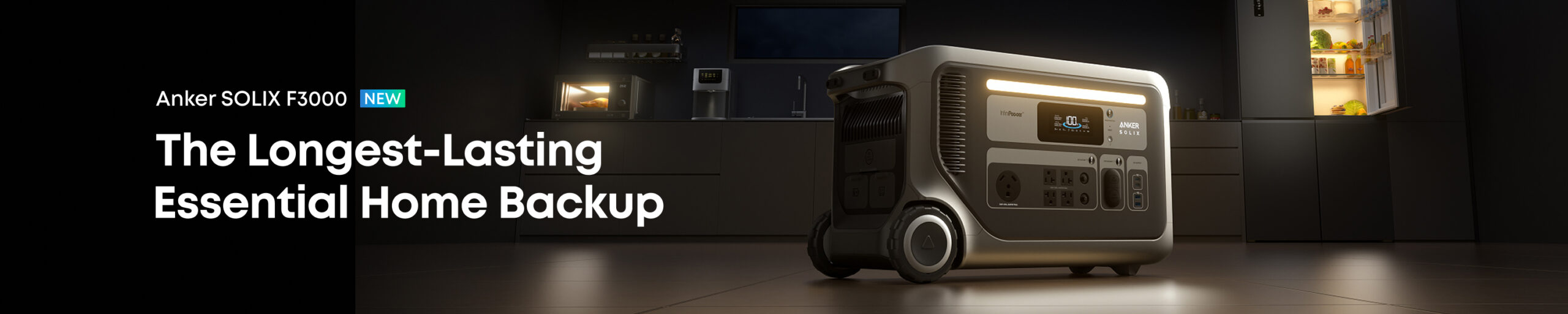
A portable power station should not be chosen by battery size first.
It should be chosen by answering a more practical question:
What absolutely cannot turn off when the power goes out?
For one buyer, that means a phone, router and laptop.
For another, it means the refrigerator, freezer and CPAP machine.
For someone else, it means a well pump, RV, workshop equipment or even 240V household appliances.
That distinction matters more than ever for Anker SOLIX Power Station Black Friday 2026 Deals, because Anker’s current U.S. range now spans compact sub-1kWh camping systems, newer 1–2kWh models such as C1000 Gen 2 and S2000, expandable C2000 Gen 2, the 3kWh F3000 and the 120V/240V F3800 family.
Before buying whichever SOLIX receives the largest Black Friday percentage discount, build your power plan first.
Four numbers to know before Black Friday
Write down:
1. Continuous watts — how much power your devices normally consume.
2. Startup or peak watts — motors and compressors can briefly demand much more than their normal running load.
3. Watt-hours needed — how long you need those devices to run.
4. Recharge opportunity — wall outlet, vehicle, alternator charger, solar panels or generator.
A simple estimate is:
Battery capacity in Wh ÷ appliance load in W = theoretical runtime in hours
Real runtime will be lower because inverters, battery electronics and the appliance itself introduce losses and variable consumption.
That small calculation can prevent a much larger Black Friday buying mistake.
Power Plan A: Keep communications and small devices alive
If your emergency list is primarily phones, tablets, laptops, lights, cameras and networking equipment, you do not automatically need a 2kWh battery.
Anker SOLIX C300
The C300 uses a 288Wh LiFePO4 battery with 300W output and a 600W surge rating. It supports high-power USB-C, including up to 140W, and can recharge through AC, USB-C, a car connection or compatible solar input.
The appeal is straightforward: this is a small power station rather than a home-backup battery.
For photographers, travelers, tent campers or somebody preparing a basic communications kit for an outage, that can be exactly the right category.
There is one important 2026 status change, though.
SOLIX’s current U.S. store lists both C300 and C300 DC as sold out. That means Amazon inventory should now be treated as a secondary or clearance opportunity rather than the foundation of this year’s deal guide.
If new Amazon stock appears at an attractive price, it can still be worthwhile. Just compare it with larger current models before paying a premium for limited stock.
Anker SOLIX C300 Portable Power Station 288Wh 300W — Check Price on Amazon
C300 DC is even more specialized
The C300 DC also stores 288Wh and can deliver up to 300W, but it is designed around DC and USB rather than conventional AC appliances. It includes two 140W two-way USB-C ports and supports up to 100W solar input.
That makes it useful for USB-C-heavy travel setups but much less universal than a power station with AC outlets.
Anker SOLIX C300 DC Portable Power Station 288Wh 300W — Check Price on Amazon
Do not buy C300 DC merely because it becomes cheaper than C300 on Black Friday. First make sure your devices do not require conventional AC outlets.
Power Plan B: Camping plus meaningful appliance capability
Once appliances enter the plan, the decision changes.
Anker SOLIX C800 Plus
C800 Plus sits in a useful middle ground with 768Wh capacity and 1,200W rated AC output, with SurgePad support up to 1,600W for suitable loads. It uses LFP cells rated for 3,000 cycles and supports up to 300W of solar input.
The unusual feature is built into the lid.
C800 Plus includes two retractable camping lights with flashlight, floodlight and candle-style modes. That gives it a reason to exist beyond simply being another battery box.
Anker specifies 58-minute full AC charging in UltraFast mode under its test conditions.
For campers and overlanders, this is therefore one of the more interesting secondary Black Friday targets.
But C800 Plus is no longer the product I would use as the central benchmark for the entire SOLIX range. The newer 1kWh and 2kWh models have become much more important.
Anker SOLIX C800 Plus Portable Power Station 768Wh 1200W — Check Price on Amazon
Power Plan C: One battery for outages, camping and everyday backup
This is probably the most competitive part of the 2026 SOLIX lineup.
Anker SOLIX C1000 Gen 2
The newer C1000 Gen 2 combines 1,024Wh capacity with 2,000W continuous output and up to 3,000W peak output. It provides 10 ports and weighs about 24.9 lb.
Its standout specification is recharge speed.
With UltraFast mode enabled in the Anker app, SOLIX specifies a full AC recharge in 49 minutes using up to 1,600W input. Solar input reaches 600W, and the UPS transfer time is rated at 10ms.
Its LFP battery is rated to retain at least 80% capacity after 4,000 cycles.
There is one tradeoff compared with the original C1000:
C1000 Gen 2 is not expansion-battery compatible. Anker specifically says the feature was omitted to improve portability.
That makes this Black Friday choice easier than it initially looks.
Choose C1000 Gen 2 if you value:
fast recharging, higher output, lower weight and 10ms UPS behavior.
Choose the original C1000 if expandable capacity matters more.
Anker SOLIX C1000 Gen 2 Portable Power Station 1024Wh 2000W — Check Price on Amazon
Original Anker SOLIX C1000 is not obsolete
Anker continues to sell the original C1000 in its U.S. lineup.
It has a slightly larger 1,056Wh capacity, 1,800W continuous AC output, 600W maximum solar input and a 20ms UPS transfer specification.
More importantly, it can use an additional 1,056Wh expansion battery, increasing the system to 2,112Wh.
That gives the older model a legitimate reason to survive.
If Black Friday heavily discounts the original C1000—or bundles it with the expansion battery—it should not automatically lose to C1000 Gen 2.
Compare the system you are actually buying.
Anker SOLIX C1000 Portable Power Station 1056Wh 1800W — Check Price on Amazon
Power Plan D: Keep the refrigerator running for much longer
This is where the 2026 lineup becomes particularly interesting.
There are now two very different ways to buy roughly 2kWh from SOLIX.
Anker SOLIX S2000: spend the battery on runtime
S2000 is a newer current SOLIX model built around efficiency rather than maximum appliance output.
It stores 2,010Wh but weighs only about 35.7 lb. AC output is rated at 1,500W continuous and up to 3,000W peak.
Anker emphasizes very low idle consumption and long essential-appliance runtime. Its comparison material positions S2000 specifically as the model for maximum backup runtime among essentials.
It also offers:
10ms UPS switching,
up to 1,600W AC input,
LFP battery chemistry,
and no expansion-battery support.
Anker rates the battery for 6,000 cycles to 80% remaining capacity and up to 10,000 cycles to 60%. Those lifespan figures come from Anker’s own testing and assumptions, so actual aging will depend on temperature and usage.
This makes S2000 a very unusual Black Friday candidate.
It is not the 2kWh model to buy simply because you want the highest inverter wattage.
It is the model to consider when runtime, size, weight and efficient low-to-moderate loads matter more.
Anker SOLIX S2000 Portable Power Station 2010Wh 1500W — Check Price on Amazon
Anker SOLIX C2000 Gen 2: spend the battery on appliance flexibility
C2000 Gen 2 goes in another direction.
It has 2,048Wh capacity and 2,400W continuous AC output, with peak capability up to 4,000W.
It also adds features that matter for RV and expandable setups:
TT-30 output
800W solar input
800W alternator-charger support
10ms UPS
and compatibility with the BP2000 Gen 2 expansion battery, increasing total storage to around 4kWh.
The unit weighs about 41.7 lb.
SOLIX specifies six charging methods and rates combined AC-plus-solar charging for a full recharge in around 58 minutes under its test conditions.
This creates one of the best comparison questions in the article:
S2000 or C2000 Gen 2?
If your priority is running moderate essential loads for as long as practical while keeping the battery compact and relatively light, S2000 deserves attention.
If you regularly need higher-output appliances, TT-30 RV connectivity or expansion to 4kWh, C2000 Gen 2 is the more flexible architecture.
A Black Friday discount should reinforce that use case—not erase it.
Anker SOLIX C2000 Gen 2 Portable Power Station 2048Wh 2400W — Check Price on Amazon
Power Plan E: You want a battery system, not merely a portable charger
Above 2kWh, portability increasingly becomes “it has wheels” rather than “pick it up and put it on a shelf.”
Anker SOLIX F3000
The F3000 is one of the most important current-generation additions to Anker’s U.S. home-backup range.
One unit stores 3,072Wh and produces up to 3,600W of AC output. Solar input reaches 2,400W through separate high- and low-voltage PV inputs.
It also supports unusually flexible recharge options.
The F3000 can accept up to 3,600W from compatible EV/generator charging arrangements and supports 3,600W pass-through operation, allowing it to recharge while continuing to power loads.
Its capacity architecture is a major reason to move up from a C-series unit.
One expansion battery takes the system to 6,144Wh, and SOLIX offers configurations scaling much further. Two F3000 power stations can also be paired through a Double Voltage Hub for 240V output and up to 7,200W. A single F3000 is a 120V unit.
At about 91.5 lb, this is not casual camping equipment. It uses wheels and a pull handle because its actual job is extended backup, RV power and off-grid use.
This is where Black Friday bundle pricing becomes especially important.
Compare:
unit only,
F3000 plus expansion battery,
F3000 plus solar,
and home-integration accessories separately.
Sometimes the bigger discount badge can conceal a bundle containing equipment you do not need.
Anker SOLIX F3000 Portable Power Station 3072Wh 3600W — Check Price on Amazon
Power Plan F: You need 240V from one power station
That requirement dramatically narrows the list.
Anker SOLIX F3800 Plus
F3800 Plus is currently the strongest primary Black Friday target at the upper end of SOLIX’s portable/home-backup lineup.
A single unit provides:
3,840Wh capacity
6,000W AC output
native 120V/240V dual-voltage support
and up to 3,200W solar input using its dual-MPPT architecture.
Unlike F3000, you do not need a second power station just to obtain 240V output.
That matters when the backup plan includes equipment such as certain pumps, dryers, workshop loads, RV systems or home circuits that genuinely require split-phase power.
F3800 Plus can also use BP3800 expansion batteries, and Anker offers multi-unit systems scaling as high as 53.8kWh and 12,000W in specified configurations.
Compared with the standard F3800, the Plus model’s most important upgrade is charging flexibility.
F3800 Plus supports up to 3,200W solar input, versus 2,400W for F3800, and adds higher-power 240V generator/wall charging capability through the relevant setup.
This is not a battery you buy casually because Black Friday makes it cheaper.
First determine whether you actually need:
240V,
whole-home integration,
several kilowatt-hours of expandable storage,
high solar input,
or EV/RV connectivity.
If you do, then the discount can become extremely meaningful.
Anker SOLIX F3800 Plus Portable Power Station 3840Wh 6000W — Check Price on Amazon
Standard F3800 still has a role
The regular F3800 remains actively sold in the U.S.
It also provides 3,840Wh, 6,000W and 120V/240V dual-voltage output, with capacity expandable using BP3800 batteries.
Its maximum solar input is 2,400W, rather than the Plus model’s 3,200W.
That means Black Friday could make the original F3800 very interesting.
If the price difference between F3800 and F3800 Plus becomes large—and you do not need the Plus model’s extra solar/generator charging capabilities—the older model could deliver most of the core backup functionality for less money.
Anker SOLIX F3800 Portable Power Station 3840Wh 6000W — Check Price on Amazon
The SOLIX products that should move to the clearance column
Not every familiar Anker power station belongs in the primary 2026 shortlist.
Anker SOLIX F2600
SOLIX’s current U.S. product page explicitly labels F2600 “Last Chance.”
The unit has 2,560Wh capacity, 2,400W continuous output, expansion-battery compatibility and up to 1,000W solar input.
Those specifications remain useful.
But with S2000, C2000 Gen 2 and F3000 now occupying important neighboring positions, F2600 needs a genuinely clearance-level price before it becomes the obvious choice.
Anker SOLIX F2600 Portable Power Station 2560Wh 2400W — Check Clearance Price on Amazon
Anker SOLIX F2000
F2000 also remains worth watching as previous-generation stock.
It offers roughly 2kWh capacity and 2,400W output, but SOLIX’s own C2000 Gen 2 comparison shows the new model is substantially lighter, recharges faster, raises peak output and improves UPS switching while retaining expansion capability.
That makes F2000 a price-first deal, not a primary 2026 target.
Anker SOLIX F2000 Portable Power Station 2048Wh 2400W — Check Clearance Price on Amazon
A solar-generator bundle is not automatically a better Black Friday deal
Amazon listings frequently combine power stations with solar panels.
Those bundles can be excellent—but check the numbers.
First confirm the power station’s maximum solar input.
Then check the panel wattage.
Buying 800W of panels for a power station that can accept only 300W at once may still have a specialized use, but it is not the same thing as receiving 800W of usable simultaneous charging input.
Among the current examples:
C800 Plus supports up to 300W solar.
C1000 and C1000 Gen 2 support up to 600W.
C2000 Gen 2 supports up to 800W.
F3000 supports up to 2,400W.
F3800 supports up to 2,400W.
F3800 Plus increases that ceiling to 3,200W.
That number should be checked before paying more for a Black Friday solar-generator package.
UPS does not mean every power station behaves exactly like a computer UPS
Several current SOLIX models advertise UPS functionality.
The transfer specifications differ.
C1000 Gen 2, S2000 and C2000 Gen 2 are rated around 10ms.
The original C1000 is specified below 20ms.
F3000 is listed at 20ms.
For routers, desktop PCs, NAS equipment, CPAP machines and other sensitive equipment, check both Anker’s compatibility guidance and the requirements of the device being protected rather than assuming every appliance will tolerate every switchover time.
Do you actually need expandability?
Black Friday shoppers often pay extra for the ability to add batteries later.
That feature is valuable only if you are realistically going to use it.
C1000 Gen 2: not expandable.
S2000: not expandable.
Original C1000: expandable to about 2.1kWh.
C2000 Gen 2: expandable to about 4kWh.
F3000: designed for much larger modular systems.
F3800/F3800 Plus: built for multi-battery home-backup configurations.
If the station will always be used as a standalone unit, paying specifically for expansion architecture may provide no benefit.
If the goal is to build a larger system over several years, it can be one of the most important specifications.
Current sale prices are not Black Friday 2026 prices
Anker SOLIX is already running promotions during September 2026, including hurricane-season offers.
Those are current promotions.
They are not confirmed Black Friday prices.
Craob will not turn today’s promotion into a fictional November deal, and we will not invent:
future Black Friday prices,
expected discount percentages,
unannounced coupon codes,
or projected savings.
When Black Friday 2026 pricing actually appears, compare the live Amazon price with the next model above and below it.
For SOLIX, that comparison matters enormously because a few hundred dollars can change:
battery capacity,
inverter output,
120V versus 240V capability,
expansion support,
solar input,
generator compatibility,
UPS behavior,
weight,
and whether the system can realistically become part of a home-backup installation.
The 2026 SOLIX shortlist
If you want to reduce the current lineup to the models that deserve the most Black Friday attention, use this framework:
C800 Plus when camping features and sub-1kWh portability matter.
C1000 Gen 2 when you want a fast-charging, high-output 1kWh standalone station.
Original C1000 when expansion matters and the deal is better.
S2000 when long essential-load runtime and compact 2kWh storage matter more than maximum output.
C2000 Gen 2 when you want a powerful, expandable 2kWh system with RV-friendly connectivity.
F3000 for serious 120V home backup, large expansion and generator/solar flexibility.
F3800 when native 240V backup is required and the older model receives a substantial discount.
F3800 Plus when you want the strongest current F3800 architecture, particularly its higher solar input and enhanced charging options.
Then keep F2600, F2000 and currently unavailable C300-series products in the secondary/clearance column.
Final take
Anker SOLIX’s 2026 lineup has become too broad for a simple “small, medium, large” buying guide.
The important question is what failure are you preparing for?
A C1000 Gen 2 can be an excellent battery and still be completely wrong for somebody planning to run 240V home equipment.
An F3800 Plus can be an extremely capable home-backup system and still be absurd overkill for somebody who only wants to keep a refrigerator and Wi-Fi online overnight.
S2000 and C2000 Gen 2 make that decision even more interesting in 2026 because buyers can now choose between two roughly 2kWh approaches: one emphasizing efficient runtime and compactness, the other emphasizing output, RV connectivity and expandability.
F3000 then bridges the gap toward true home-backup systems, while F3800 and F3800 Plus move into native 120V/240V territory.
So when Anker SOLIX Power Station Black Friday 2026 deals go live, do not begin with the discount.
Begin with the load.
Then the runtime.
Then the recharge method.
Then the expansion plan.
Once those four answers are clear, the cheapest SOLIX that meets all four is usually the deal worth buying.