
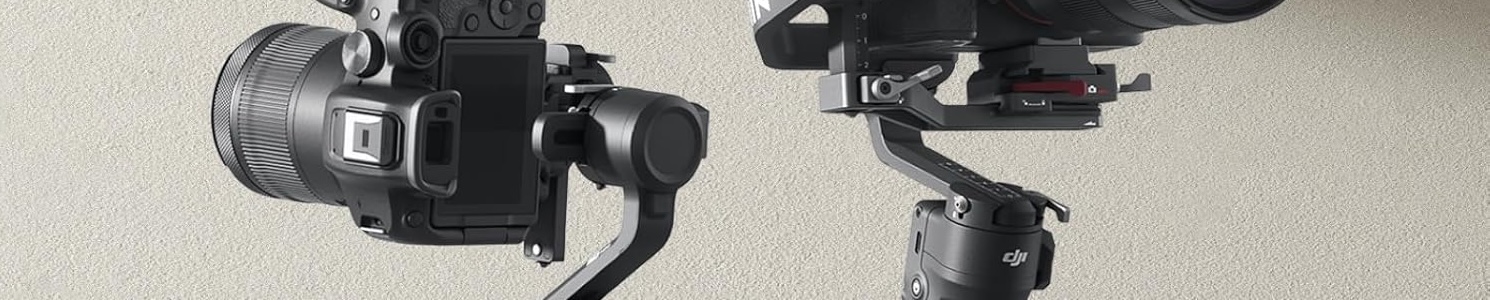
Before shopping for a DJI RS gimbal this Cyber Monday, do something most deal pages never tell you to do:
Weigh your camera rig.
Not just the camera body.
Add the lens you actually shoot with, cage, filter, microphone, receiver, SSD, focus motor and anything else that will sit on the gimbal.
That number immediately tells you whether you should be looking at:
- DJI RS 4 Mini
- DJI RS 5
- DJI RS 4
- DJI RS 4 Pro
- or an older RS 3 Mini clearance deal
A $200 discount is useless if the gimbal cannot comfortably stabilize your real camera setup.
So for DJI RS Gimbal Stabilizer Cyber Monday 2026 Deals, CRAOB is organizing the buying decision by rig weight and production complexity, not by which gimbal has the largest percentage-off badge.
Step 1: Weigh the rig you actually shoot
DJI’s current family breaks down roughly like this:
| DJI stabilizer | Tested payload | Gimbal weight | Best fit |
|---|---|---|---|
| RS 3 Mini | 2 kg / 4.4 lb | 795 g | Budget/light mirrorless rigs |
| RS 4 Mini | 2 kg / 4.4 lb | 890 g | Creators, compact mirrorless, tracking |
| RS 4 | 3 kg / 6.6 lb | 1.4 kg | Older commercial mirrorless platform |
| RS 5 | 3 kg / 6.6 lb | 1.46 kg | Current mainstream commercial/solo creator model |
| RS 4 Pro | 4.5 kg / 10 lb | 1.6 kg | Heavy mirrorless and cinema rigs |
DJI itself currently positions RS 5 as the lightweight commercial stabilizer, RS 4 Pro as the expansive flagship, and RS 4 Mini as its compact creator option.
Payload numbers are not invitations to operate permanently at the absolute limit.
A lighter rig generally balances more easily, places less demand on the motors and gives you more flexibility when changing lenses or adding accessories.
Your rig is lightweight: DJI RS 4 Mini
Best for creators who value portability
The DJI RS 4 Mini is the current compact RS model and is likely to be one of the most attractive Cyber Monday choices for mirrorless users.
It supports a tested payload of 2 kg / 4.4 lb while the gimbal itself weighs about 890 g / 2 lb.
That makes it well suited to compact setups such as:
- Sony a7C-series cameras
- Sony APS-C bodies
- Canon EOS R8/R50-class cameras
- Nikon Z mirrorless bodies with compact lenses
- Fujifilm creator rigs
- Panasonic compact mirrorless systems
- smartphones with appropriate accessories
The important RS 4 Mini upgrades are workflow improvements rather than simply stronger motors.
DJI includes:
- second-generation automated axis locks
- Teflon-enhanced balancing surfaces
- native vertical shooting
- intelligent tracking support
- responsive follow mode
- camera and smartphone compatibility
That combination makes it particularly attractive for solo content creators who regularly move between horizontal YouTube footage and vertical social content.
DJI RS 4 Mini Gimbal Stabilizer — Check Price on Amazon
RS 4 Mini: standard or Combo?
This is one of the Cyber Monday comparisons worth making carefully.
DJI currently lists:
RS 4 Mini: $309
RS 4 Mini Combo: $369.
The Combo is more useful for operators who want the intelligent tracking module/expanded shooting setup rather than just the core stabilizer.
And we already have a meaningful 2026 sale benchmark.
$319 for the Combo has already happened
Amazon sold the DJI RS 4 Mini Combo for $319 in June 2026.
Earlier spring promotions had put that same Combo around $359–$369.
That gives CRAOB a straightforward Cyber Monday reference:
$369: current DJI pricing.
$319: proven strong Amazon 2026 territory.
If Cyber Monday brings it back to $319, that’s competitive.
If Amazon materially beats $319, that’s more noteworthy.
DJI RS 4 Mini Combo — Check Price on Amazon
Your rig is around the 3 kg class: DJI RS 5
The most important new RS model for Cyber Monday 2026
DJI officially launched the RS 5 on January 29, 2026.
It replaces RS 4 as DJI’s newest mainstream commercial stabilizer while retaining the same 3 kg / 6.6 lb tested payload class.
That means RS 5 is not primarily about suddenly carrying a much larger camera.
It is about making a 3 kg-class rig easier to operate.
The major improvements include:
- fifth-generation stabilization algorithm
- increased peak motor torque
- enhanced intelligent tracking
- on-screen subject selection
- tracking of people, vehicles, pets and other subjects
- fine-adjustment controls across the axes
- second-generation automated axis locks
- new Z-axis movement indicator
- faster charging
- improved runtime
- new electronic briefcase handle support
DJI says RS 5 can fully charge in about one hour and offers approximately 14 hours of standby runtime with its standard battery.
Why the RS 5 Combo matters
The standard RS 5 is currently $569.
The RS 5 Combo is $719.
That $150 difference isn’t just packaging.
The Combo adds two of RS 5’s most interesting workflow accessories:
- RS Enhanced Intelligent Tracking Module
- Electronic Briefcase Handle
The tracking module allows subject selection directly through the gimbal touchscreen.
The briefcase handle adds gimbal and camera controls for low-angle and underslung shooting.
For a wedding shooter or solo commercial videographer, both can be genuinely useful.
For someone who simply wants smooth walking shots with a mirrorless camera, the standard kit may be enough.
DJI RS 5 Gimbal Stabilizer — Check Price on Amazon
DJI RS 5 Combo — Check Price on Amazon
Don’t invent an RS 5 Cyber Monday low
This is especially important because RS 5 is new.
DJI and major U.S. retailers are still broadly listing the standard model around $569 and the Combo around $719. Best Buy currently reflects those prices as well.
There is not yet the kind of repeatable Amazon sale history we have for RS 4 Mini or RS 3 Mini.
So CRAOB should not publish statements such as:
“Wait for $449.”
“Expected Cyber Monday price: $499.”
“Likely 30% off.”
There is no verified evidence for those numbers.
For now:
RS 5: $569 baseline
RS 5 Combo: $719 baseline
Any real Cyber Monday offer should be evaluated when it actually appears.
RS 5 or RS 4? This may be the real deal question
The outgoing DJI RS 4 is still a very capable stabilizer.
Like RS 5, it supports a 3 kg / 6.6 lb payload.
It also provides:
- second-generation automated axis locks
- second-generation native vertical shooting
- Teflon-coated axis arms
- joystick zoom/gimbal control
- RSA accessory port
- support for DJI’s professional accessory ecosystem
DJI currently references the RS 4 at $469, although its U.S. direct-store listing is presently out of stock.
That’s already $100 less than RS 5.
Cyber Monday could widen the gap.
$399 is an important RS 4 reference
A major authorized U.S. retailer offered the DJI RS 4 for $399 in summer 2026, $70 below its $469 reference price.
That gives us a useful benchmark even though it is not an Amazon-specific historical low.
If Amazon Cyber Monday pricing pushes the RS 4 toward $399 or lower, ask whether RS 5’s workflow improvements are worth the extra cost.
For some creators they will be.
For others, they won’t.
DJI RS 4 Gimbal Stabilizer — Check Price on Amazon
When the outgoing RS 4 is the smarter purchase
Consider RS 4 instead of RS 5 when:
- your rig already balances easily;
- you don’t need the newest tracking module;
- automated subject selection isn’t important;
- you rarely use a briefcase handle;
- charging speed is not a major issue;
- a large Cyber Monday price difference appears.
Both stabilizers occupy essentially the same payload class.
That means a photographer buying an RS 5 solely because “5 is newer than 4” may be spending unnecessarily.
When RS 5 earns the premium
Choose RS 5 when:
- you are a solo operator;
- tracking saves you real setup time;
- you use low-angle shots constantly;
- easier fine balancing matters;
- you switch setups repeatedly during a shoot;
- faster charging matters;
- your production work justifies paying for workflow improvements.
The RS 5 upgrade is less about what camera fits and more about how quickly and intelligently you can operate the gimbal.
Your camera setup is heavy: DJI RS 4 Pro
The 4.5 kg / 10 lb option
This is the line in DJI’s current family where payload changes substantially.
The DJI RS 4 Pro supports a tested payload of 4.5 kg / 10 lb, compared with 3 kg on RS 5/RS 4 and 2 kg on RS 4 Mini.
DJI uses carbon-fiber axis arms and gives the Pro more headroom for heavier combinations such as:
- cinema cameras
- large full-frame bodies
- heavy f/2.8 zooms
- cages
- external accessories
- focus motors
- video transmitters
- larger production rigs
DJI also states that RS 4 Pro increased motor torque by 20% over its prior generation.
RS 4 Pro is about an ecosystem, not merely stronger motors
The Pro model supports workflows that the smaller RS products are not designed to replicate fully.
Its ecosystem includes:
- dual Focus Pro motor control
- Focus Pro LiDAR
- remote focus/zoom workflows
- DJI video transmission integration
- high-bright remote monitor support
- RS SDK configurations
- extended battery options
DJI’s Focus Pro LiDAR system provides 76,800 ranging points and subject focusing out to approximately 20 meters under DJI’s specifications.
For an independent filmmaker or production crew, these features can matter far more than the basic stabilization specification.
For someone mounting a Canon R8 with a small prime, they’re unnecessary.
DJI RS 4 Pro Gimbal Stabilizer — Check Price on Amazon
RS 4 Pro pricing: don’t invent a bargain threshold
DJI currently lists:
RS 4 Pro: $869
RS 4 Pro Combo: $1,099.
Unlike RS 4 Mini, I do not have sufficiently strong, repeatable 2026 Amazon evidence to declare an exact RS 4 Pro Cyber Monday threshold such as $699 or $749.
So CRAOB should avoid manufacturing one.
Instead, judge an actual Cyber Monday offer against the verified $869/$1,099 current U.S. references.
DJI RS 4 Pro Combo — Check Price on Amazon
Why the RS 4 Pro Combo costs more
The Pro Combo is intended for a more complete production workflow.
DJI describes its Combo as adding professional control accessories including the Focus Pro Motor and carrying case.
Before buying, calculate whether you actually plan to motorize focus or zoom.
If not, a discounted standard RS 4 Pro may be the more sensible purchase.
If yes, compare the Combo with the cost of assembling the same components separately.
Cyber Monday bundle math matters more once your stabilizer purchase moves above $1,000.
The sleeper clearance deal: DJI RS 3 Mini
The older DJI RS 3 Mini deserves a place in this article for one reason:
$179.
Amazon sold the RS 3 Mini for $179 in August 2026, and the same price appeared again in September.
Price-history tracking identifies $179 as its tracked low over roughly three years.
DJI currently references the model at $199, although direct stock is unavailable.
DJI RS 3 Mini Gimbal Stabilizer — Check Price on Amazon
RS 3 Mini versus RS 4 Mini: the $130 question
Both carry a 2 kg / 4.4 lb tested payload.
The RS 3 Mini is actually lighter:
RS 3 Mini: 795 g
RS 4 Mini: 890 g.
At current reference pricing:
RS 3 Mini: around $179–$199
RS 4 Mini: $309
That difference can exceed $100.
Why pay it?
RS 4 Mini adds much more modern workflow features such as:
- automated axis locks
- improved balancing
- more advanced tracking options
- third-generation native vertical shooting workflow
- newer stabilization generation
- smartphone compatibility
For someone shooting professionally every week, those conveniences may be worth it.
For a hobbyist using a lightweight camera five times a year, the $179 RS 3 Mini can be very difficult to ignore.
Camera weight is not the same as rig weight
This is probably the most important technical mistake gimbal buyers make.
Suppose a camera body weighs 1.3 lb.
The listing says RS 4 Mini handles 4.4 lb.
Easy.
Except your actual setup might include:
- 1.3 lb camera
- 1.8 lb 24-70mm f/2.8 lens
- cage
- microphone receiver
- variable ND
- quick-release hardware
- external SSD
Now the calculation looks very different.
Before ordering, assemble the exact configuration and weigh it.
If the rig is already approaching the stabilizer’s payload ceiling, move up a class.
Lens length matters too
Payload is not the only factor.
A physically long lens creates a different balancing problem from a compact lens of equal weight.
For example, a short prime can be much easier to balance than a large telephoto zoom.
The center of gravity may shift dramatically when:
- zooming an extending lens;
- changing focus;
- installing an ND system;
- attaching a matte box;
- adding a focus motor.
Check DJI’s camera compatibility documentation for the exact camera/lens combination whenever possible.
A gimbal specification cannot guarantee that every 4.4 lb or 6.6 lb shape will balance equally well.
The 24-70mm f/2.8 test
If you’re trying to decide between Mini and full-size RS models, consider the lens you use most.
A compact prime or lightweight zoom?
RS 4 Mini may be enough.
A large full-frame body with a professional 24-70mm f/2.8 plus accessories?
RS 5/RS 4 gives you considerably more headroom.
Cinema body, cage, follow focus, large lens and transmitter?
Look toward RS 4 Pro.
Buy around your heaviest regularly used configuration—not the smallest one.
Horizontal and vertical creators need different things
If 90% of your work is traditional horizontal commercial video, vertical-switching convenience may not be worth paying extra for.
If you regularly deliver:
- YouTube
- Instagram Reels
- TikTok
- vertical ads
- Shorts
in the same shoot, native vertical workflows become much more valuable.
DJI has continued improving this across newer RS generations, with RS 4 Mini providing its third-generation native vertical implementation while RS 4 and RS 4 Pro use second-generation native vertical shooting.
That can save real production time.
Solo creators should pay attention to tracking
Traditional gimbals require someone to operate them.
Newer DJI systems increasingly blur that distinction.
RS 4 Mini introduced an intelligent tracking workflow.
RS 5 expands it with the Enhanced Intelligent Tracking Module, allowing the operator to select subjects from the gimbal touchscreen and track not only people but vehicles, pets and other subjects.
That matters when you’re filming yourself.
Imagine:
- cooking videos
- fitness instruction
- solo product shoots
- automotive content
- creator tutorials
- self-recorded interviews
A tracking module can sometimes replace a second person for simple camera moves.
That’s a much more meaningful reason to buy RS 5 than “newer stabilization algorithm.”
Don’t ignore the weight of the gimbal itself
A heavier gimbal can stabilize a heavier camera.
It also has to be held.
Approximate gimbal weights:
RS 3 Mini: 795 g
RS 4 Mini: 890 g
RS 4: 1.4 kg
RS 5: 1.46 kg
RS 4 Pro: 1.6 kg.
Then add the camera.
Then the lens.
Then accessories.
A 1.46 kg RS 5 carrying a 2.5 kg setup is already roughly 4 kg before handles and extra hardware.
Hold that at chest height for ten minutes and the specification sheet starts feeling very different.
For weddings and long event days, the lightest gimbal that comfortably handles the rig can be the better professional tool.
Combo doesn’t always mean better value
DJI sells several configurations:
- standard
- Combo
- Creator Combo
- SDR Transmission combinations
- bundles with microphones
- accessory packages
Do not compare the discount percentages until you compare what’s actually inside.
A Combo makes sense only if you were going to buy those accessories anyway.
For example:
RS 5
Standard: $569
Combo: $719
If you value the tracking module and electronic briefcase handle, the Combo deserves close attention.
If not, you’ve simply spent $150 more.
Be skeptical of third-party “filmmaker bundles”
Amazon and camera retailers may add their own packages containing:
- memory cards
- cleaning kits
- cases
- power banks
- generic lights
- microphones
- cables
- dual handles
Some bundles are useful.
Others exist mainly to make the package look larger.
Compare the core DJI hardware first.
Then assign realistic value to accessories you would have purchased independently.
A $799 package isn’t automatically superior to a $719 DJI Combo because it contains eight inexpensive accessories.
Five prices to keep open on Cyber Monday
These are verified 2026 reference points, not predictions.
| DJI RS product | Useful 2026 reference |
|---|---|
| RS 3 Mini | $179 Amazon Aug./Sept. |
| RS 4 Mini | $309 current DJI price |
| RS 4 Mini Combo | $319 Amazon June 2026 |
| RS 4 | $399 major U.S. retailer sale |
| RS 5 | $569 current U.S. baseline |
| RS 5 Combo | $719 current U.S. baseline |
| RS 4 Pro | $869 current DJI price |
| RS 4 Pro Combo | $1,099 current DJI price |
For RS 5 and RS 4 Pro, the absence of a dramatic historical deal number is useful information itself.
It means we should wait for the actual Cyber Monday offer rather than invent one.
Cyber Monday scenario: RS 4 Mini Combo at $319
That’s already proven 2026 Amazon pricing.
It can still be a good deal.
It simply should not be marketed as an unprecedented holiday low without additional evidence.
Cyber Monday scenario: RS 3 Mini at $179
That matches its recent Amazon low.
For lightweight hobbyist rigs, it remains extremely compelling.
Cyber Monday scenario: RS 4 at $399
That matches strong major-retailer summer pricing.
The important comparison would then be RS 5 at whatever price it reaches.
If RS 5 remains $569, a $170 difference is meaningful.
Cyber Monday scenario: RS 5 gets its first major discount
This is one of the events worth watching most closely.
Because the model launched in January 2026 and still sells broadly around $569/$719, Cyber Monday could establish a more meaningful U.S. price benchmark.
But CRAOB should update the article only after that price exists.
No predictions.
Cyber Monday scenario: RS 4 Pro drops substantially
This could create a different decision entirely.
RS 4 Pro does not compete with RS 5 solely on generation.
It still supports a higher 4.5 kg payload and deeper professional-control ecosystem.
So a discounted RS 4 Pro could remain the better tool than RS 5 for heavy rigs even though RS 5 is newer.
Which DJI RS should you monitor?
Budget lightweight mirrorless rig
DJI RS 3 Mini Gimbal Stabilizer — Check Price on Amazon
2026 benchmark: $179
Compact creator rig with newer workflow features
DJI RS 4 Mini Gimbal Stabilizer — Check Price on Amazon
Current DJI reference: $309
Compact solo-creator system with tracking
DJI RS 4 Mini Combo — Check Price on Amazon
2026 Amazon benchmark: $319
Outgoing 3 kg commercial platform
DJI RS 4 Gimbal Stabilizer — Check Price on Amazon
Major U.S. 2026 benchmark: $399
Current 3 kg commercial target
DJI RS 5 Gimbal Stabilizer — Check Price on Amazon
Current baseline: $569
Best RS 5 option for solo commercial operators
DJI RS 5 Combo — Check Price on Amazon
Current baseline: $719
Heavy mirrorless/cinema rig
DJI RS 4 Pro Gimbal Stabilizer — Check Price on Amazon
Current baseline: $869
Heavy rig with focus-control accessories
DJI RS 4 Pro Combo — Check Price on Amazon
Current baseline: $1,099
The most important Cyber Monday comparison isn’t RS 4 vs RS 5
It’s this:
What does your entire camera rig weigh after it is ready to record?
If it’s comfortably below 2 kg, start with RS 4 Mini.
If it needs 3 kg of headroom, compare RS 5 with discounted RS 4.
If the rig is genuinely heavy or part of a professional cinema-control ecosystem, start with RS 4 Pro.
And if you’re using a compact mirrorless camera and don’t need intelligent tracking, watch the $179 RS 3 Mini clearance lane.
The wrong stabilizer doesn’t become right because Cyber Monday takes 30% off it.
The right DJI RS deal is the model that gives your actual camera setup enough payload headroom, enough control for your workflow and no unnecessary weight—at a price that genuinely improves on what U.S. shoppers have already seen during 2026.